
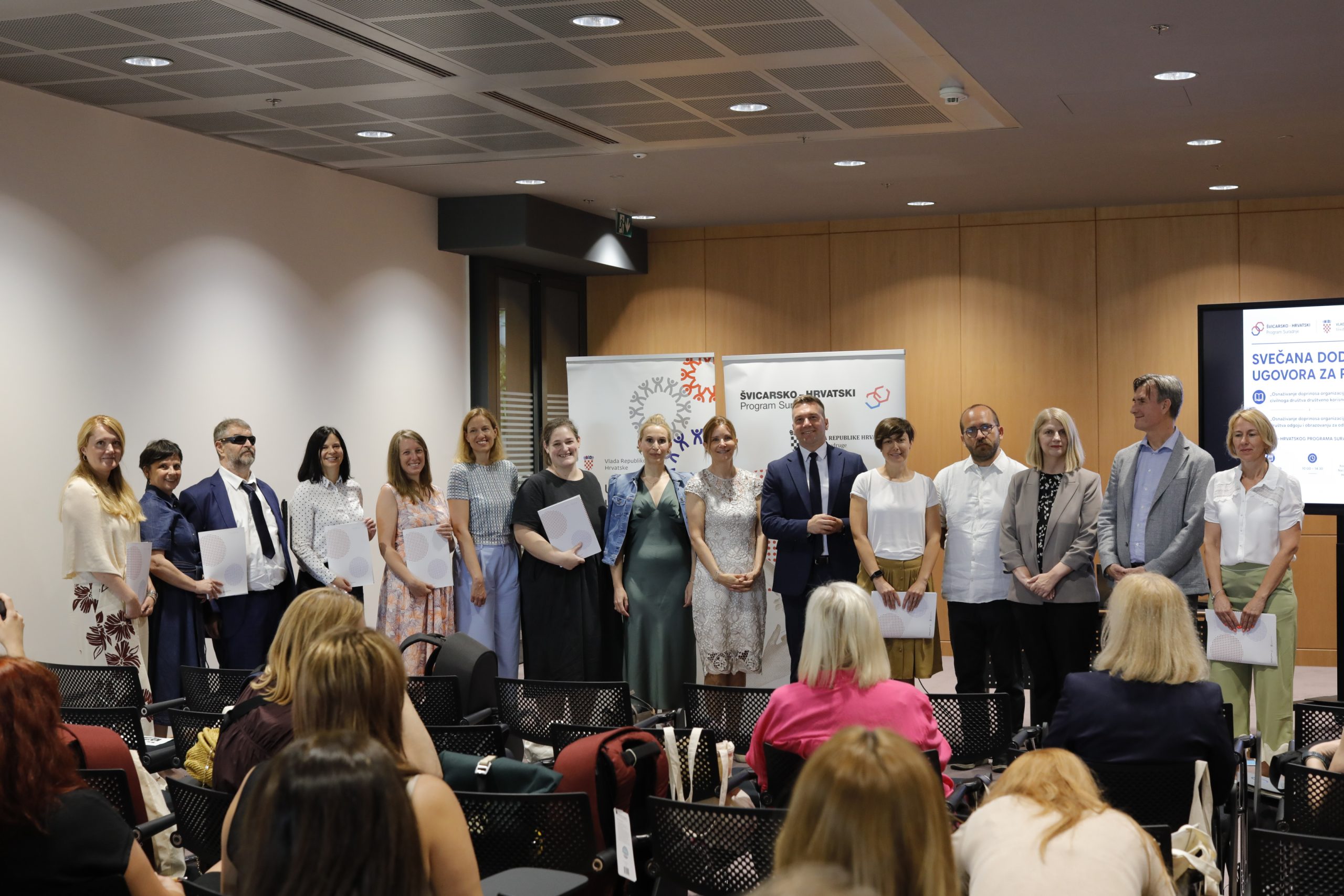
A formal ceremony for the award of contracts under the Civil Society Programme of the Second Swiss Contribution to the Republic of Croatia was held on 20 July 2026 at the Conference Centre of the National and University Library in Zagreb. The Government Office for Cooperation with NGOs, as the Programme Operator, awarded a total of ten contracts worth nearly EUR 2.5 million – eight contracts for projects in the field of community-based learning, with a total value of EUR 2,026,648.79, and two contracts for projects in the field of education for sustainable development, worth EUR 455,025.10.
The ceremony brought together representatives of institutions, civil society organisations, higher education institutions, educational institutions, and other stakeholders involved in the development of civil society and education.
In the opening session, the participants were addressed by Helena Beus, Acting Director of the Government Office for Cooperation with NGOs, Momir Karin, Director of the Directorate for Support and Improvement of the Education System at the Ministry of Science, Education and Youth, Domagoj Mikulić, State Secretary at the Ministry of Regional Development and EU Funds, Majda Burić, Vice-Chair of the Committee on European Affairs and Representative of the President of the Croatian Parliament, and Beatrice Schaer, Ambassador of the Swiss Confederation to the Republic of Croatia.
The awarded contracts are the result of successfully implemented calls for proposals: “Strengthening the Contribution of Civil Society Organisations to Community-Based Learning” and “Strengthening the Contribution of Civil Society Organisations to Education for Sustainable Development.”
The call for community-based learning supported the development of sustainable partnerships between civil society organisations and higher education institutions. Through the implementation of approved projects, students and higher education staff will participate in activities that connect academic knowledge with the concrete needs of the community. In this way, the professional and analytical capacities of civil society organisations will be strengthened, while active citizenship and youth engagement will be encouraged.
The projects will connect universities, civil society organisations and local communities in addressing various social challenges – from environmental protection and climate change to the inclusion of persons with disabilities, combating disinformation and promoting active citizenship.
The second call, focused on education for sustainable development, further strengthens the role of civil society organisations in developing knowledge, skills and competences among children and young people for active and responsible participation in society.
The supported projects aim to strengthen cooperation between civil society organisations and educational institutions, develop innovative educational content and teaching methods, and raise awareness of the importance of sustainable development, environmental protection, social equality and responsible resource management.
Through the implementation of these projects, hundreds of students, pupils, teachers and members of civil society organisations will have the opportunity to acquire new knowledge and skills while contributing to the creation of more sustainable, resilient and inclusive local communities.
The Second Swiss Contribution represents the continuation of Switzerland’s investments aimed at reducing economic and social inequalities in European Union Member States. In Croatia, it is implemented through activities in several areas, including research programmes and the EUROSTARS programme, the improvement of water supply infrastructure in Gorski kotar, the development of the palliative care system, and the strengthening of civil society.
The contract award ceremony also provided an opportunity to highlight the importance of partnerships between public institutions, civil society organisations, the education system and international partners in creating a society that actively responds to present and future challenges.
Following the ceremony, an implementation workshop was held for beneficiaries, during which key information and guidance for the successful implementation of approved projects were presented.
The award ceremony was also covered by HRT https://share.google/No0IbeEibP6gSxm2m i tportalu https://share.google/KLTcI0KwxD9oSmjMg,